
Introduction
The White-bearded Manakin (Manacus manacus) is a fascinating species of perching bird that captures the imagination of ornithologists and birdwatchers alike. Belonging to the Pipridae family, this small, energetic bird is widely recognized for its spectacular courtship displays and distinct monochromatic appearance. Primarily found in the tropical regions of South America, the White-bearded Manakin plays an essential role in its ecosystem, particularly as a seed disperser for various forest plants. While they may be small in size, their presence in the dense understory of tropical forests is often announced by their loud, snapping vocalizations. Understanding this species requires a deep dive into its unique social structure, particularly the 'lek' system, where males gather to compete for the attention of females. As we explore the life of the Manacus manacus, we uncover a world of complex behaviors, specialized adaptations, and a vibrant life cycle that remains a cornerstone of avian studies in the Neotropics. Whether you are a seasoned researcher or a casual enthusiast, the White-bearded Manakin offers a captivating glimpse into the diversity of tropical forest dwellers.
Physical Appearance
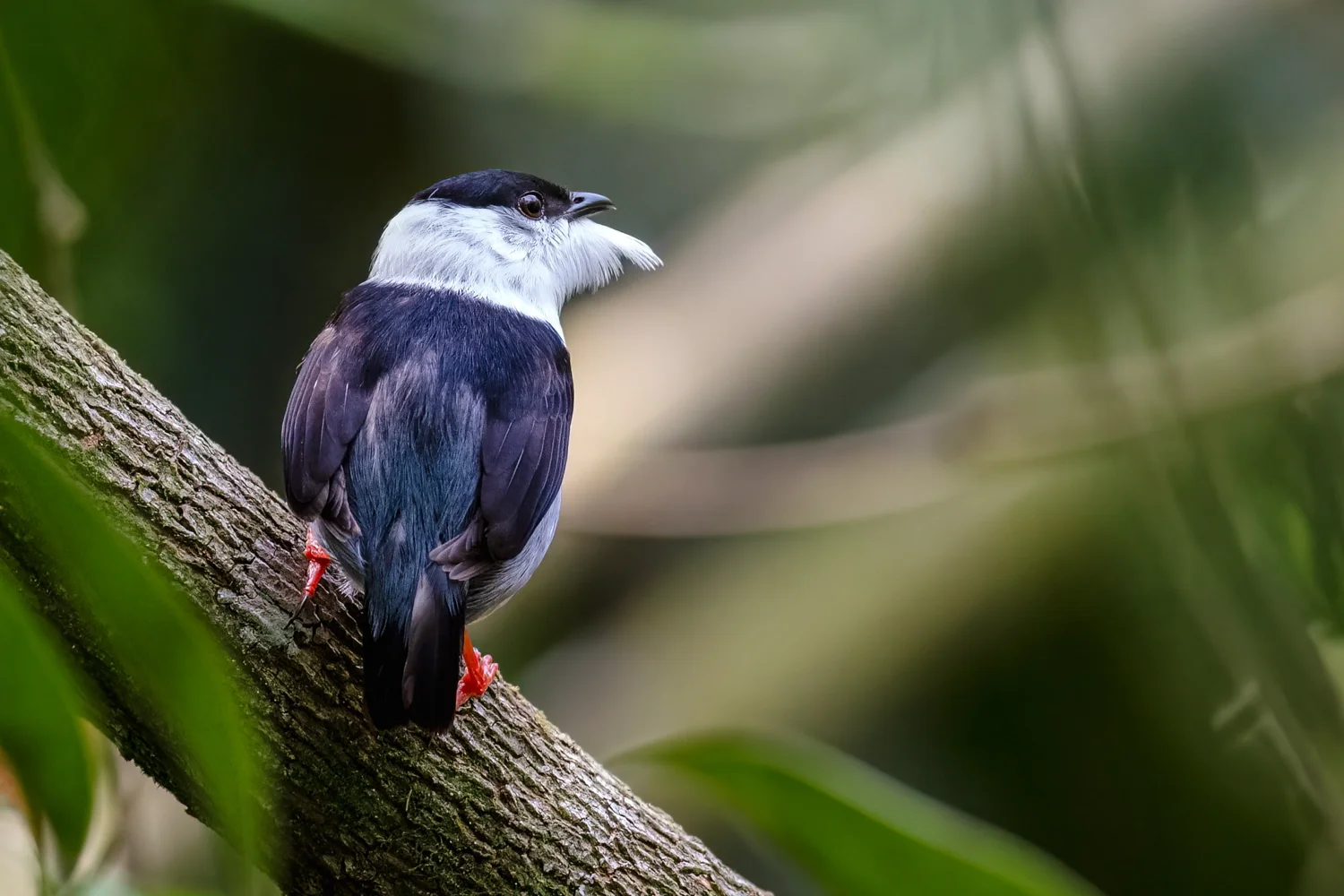
Measuring approximately 10 to 11 centimeters in length, the White-bearded Manakin is a compact yet striking bird. The species exhibits significant sexual dimorphism, which is common among manakins. Adult males are arguably the most eye-catching, featuring a brilliant white throat and collar that gives them their common name. The rest of their plumage is dominated by a deep, glossy black, which contrasts sharply against their white beards and often pale or yellowish legs. Their wings are relatively short and rounded, designed for quick, agile movements through dense foliage. In contrast, females and immature males display a much more understated appearance, typically sporting olive-green or grayish-green plumage. This camouflage is essential for their survival, as it allows them to blend seamlessly into the forest understory, protecting them from predators while they tend to their nests. Despite these differences, both sexes share a short, stout beak, which is perfectly adapted for their specific diet of small fruits and berries. The physical structure of the White-bearded Manakin is a testament to the evolutionary pressures of life in the dense tropical undergrowth, balancing visual display with functional utility.
Habitat
The White-bearded Manakin is primarily a resident of the humid, lowland tropical forests of South America. They are commonly found in the understory and lower canopy levels, where they prefer areas with thick vegetation, such as forest edges, second-growth forests, and sometimes even coffee or cacao plantations. Their distribution spans from the Guianas and Venezuela through the Amazon basin to parts of Brazil and Argentina. They thrive in environments that offer a consistent supply of small, soft fruits, which are their main dietary staple. Because they are highly dependent on forest structure for their elaborate lekking displays, the preservation of dense, connected forest patches is vital for their continued survival and reproductive success across their vast range.
Diet
As a frugivorous species, the White-bearded Manakin relies heavily on a diet consisting primarily of small fruits and berries. They are known to be opportunistic feeders, often visiting various fruiting trees throughout their territory. By consuming these fruits, they act as critical seed dispersers for many plant species, supporting the health and regeneration of their tropical forest homes. While fruit makes up the bulk of their nutritional intake, they have also been observed supplementing their diet with small insects, particularly during the breeding season when higher protein levels are necessary for growth and energy. Their foraging style is quick and precise; they often pluck fruits on the wing, hovering momentarily before returning to a nearby perch to consume their meal.
Breeding and Nesting
The breeding behavior of the White-bearded Manakin is centered around the concept of the 'lek.' In these communal display arenas, multiple males gather to perform acrobatic feats and produce loud, mechanical snapping sounds with their wings to attract females. These displays are highly competitive and mesmerizing to witness. Once a female chooses a mate, the male plays no further role in the nesting process. The female is solely responsible for building a shallow, cup-shaped nest, typically placed in the fork of a tree branch or shrub, often hidden by dense foliage. She lays a small clutch of eggs, usually two, and incubates them for about two weeks. The female also takes on the full responsibility of feeding the chicks, which requires frequent trips to gather enough fruit and small insects to support their rapid growth before they fledge the nest.
Behavior
Behaviorally, the White-bearded Manakin is best known for its high-energy, social interactions. Outside of the breeding season, they can be somewhat solitary, but the lekking season transforms their behavior into a highly social and competitive display. They are incredibly agile fliers, capable of sudden, rapid maneuvers that are essential for both their courtship displays and for escaping potential predators in the cluttered forest understory. Their vocalizations are just as distinctive as their physical movements; they are not known for melodious songs but rather for their sharp, snapping, and buzzing sounds that carry through the forest. These noises are produced mechanically by the rapid vibration of their modified wing feathers, a unique adaptation that serves as a hallmark of the manakin family.
Conservation Status - LC Least Concern
Currently, the White-bearded Manakin is classified as a species of Least Concern by the IUCN. Their population remains stable across much of their extensive range in South America. However, this does not mean they are immune to environmental threats. The primary challenge facing these birds is the ongoing loss and fragmentation of tropical forest habitats due to deforestation and agricultural expansion. Protecting the integrity of the forest understory is essential for maintaining their specialized lekking sites. Ongoing conservation efforts focus on habitat restoration and the creation of protected corridors to ensure these birds can continue their unique life cycles.
Interesting Facts
- The 'snap' sound during their courtship display is made by their wings, not their mouths.
- Males are exclusively responsible for the elaborate lekking displays to attract females.
- They are vital seed dispersers, helping maintain the biodiversity of the tropical forest.
- Females build their nests without any assistance from the males.
- Their wings have evolved specialized feathers to produce mechanical sounds during flight.
- They are known to be highly territorial during the peak of the breeding season.
- The White-bearded Manakin is one of the most widely distributed species in the manakin family.
Tips for Birdwatchers
For birdwatchers hoping to spot the White-bearded Manakin, patience is the ultimate virtue. The best approach is to visit known lekking sites, which are often active in the early morning hours. Listen for their signature 'snapping' sounds, which act as a beacon for their presence in the dense undergrowth. Because these birds are small and move quickly, using binoculars with a fast focus and a wide field of view is recommended. Keep your distance to avoid disrupting their delicate courtship rituals. If you are in a tropical region, local guides are often invaluable, as they can identify the specific fruiting trees where these birds are most likely to forage and congregate throughout the day.
Conclusion
The White-bearded Manakin is a true marvel of the avian world, embodying the vibrant energy and complex evolutionary adaptations of South American tropical forests. From their striking black and white plumage to their mechanical wing-snapping displays, every aspect of their biology is finely tuned to their environment. As we have explored, their role as seed dispersers is not merely a biological function but a cornerstone of forest health, illustrating the interconnectedness of all life within these ecosystems. While they currently enjoy a stable conservation status, the White-bearded Manakin serves as a reminder of the importance of preserving the dense, humid forests that serve as their home. By studying and appreciating these small but significant birds, we gain a deeper understanding of the intricate behaviors and ecological requirements that define life in the tropics. Whether you are observing them in the wild or learning about them through research, the White-bearded Manakin continues to provide endless fascination and serves as a compelling subject for ornithologists and nature lovers worldwide. Protecting their habitat ensures that future generations can continue to witness the breathtaking displays that define this remarkable species.
